

Table of Contents
- What is a Marketing Strategy for Growing Companies?
- Building a Full-Funnel Marketing Strategy for Growing Businesses
- Digital Marketing Strategies for Growing Businesses
- Content Marketing for Business Growth and SEO Integration
- Target Audience Identification and Buyer Persona Development
- Marketing Budget for Growing Companies: Unit Economics and ROI
- Customer Acquisition and Growth Engine Optimization
- Implementing Your Marketing Strategy: Change Management and Execution
Last Updated: July 31, 2026
What is a Marketing Strategy for Growing Companies?
A marketing strategy for growing companies is a data-driven plan designed to acquire customers efficiently, retain them profitably, and scale revenue without proportional spending increases. Unlike traditional marketing focused on brand awareness, growth-focused strategies treat marketing as a measurable system where every dollar connects directly to business outcomes.
Growth Marketing vs. Traditional Marketing
Growth marketing and traditional marketing serve different purposes. Traditional marketing emphasizes brand building and awareness, measuring success through impressions and reach. Growth marketing focuses on measurable outcomes: customer acquisition cost, lifetime value, conversion rates, and revenue per marketing dollar.
Traditional marketing asks: "How many people know about us?" Growth marketing asks: "How many customers did we acquire, at what cost, and how much revenue will they generate?" Growing companies cannot afford to spend money on awareness that doesn’t impact revenue.
Why Scaling Requires a Different Approach
The tactics that work when you’re small fail at scale. When you exhaust your network, personal relationships cannot drive acquisition alone. You need repeatable systems that don’t depend on individual effort.
As you grow, you must understand which channels deliver customers at affordable costs and which customers stay around. You need to optimize for unit economics, the financial relationship between acquisition spending and customer lifetime value. A marketing strategy for growing companies must build a growth engine: a system where each component feeds into the next, where you measure everything, test variations, and double down on what works.
Growing companies need fundamentally different marketing than established brands. The shift is from brand awareness to measurable customer acquisition, from gut-feel decisions to data-driven optimization, and from one-off campaigns to repeatable systems.
Building a Full-Funnel Marketing Strategy for Growing Businesses
A full-funnel marketing strategy addresses the entire customer journey from awareness through purchase and beyond. Most growing companies focus only on top-of-funnel awareness without building systems to convert that awareness into customers.
Awareness to Conversion: The Complete Customer Journey
A complete customer journey moves through four stages: awareness, consideration, decision, and retention.
Awareness stage: Prospects discover your company exists. Target specific buyer personas in industries where your solution delivers clear value.
Consideration stage: Prospects research whether your solution fits their needs and compare you to competitors. Case studies, comparison guides, webinars, and detailed product information help prospects evaluate options.
Decision stage: Prospects are ready to buy. Sales conversations, product demos, and customer testimonials drive conversions.
Retention stage: After purchase, focus on ensuring customers achieve desired outcomes, reducing churn, and creating expansion opportunities. A customer acquired for $1,000 who stays two years and generates $5,000 in revenue is vastly more valuable than one who churns after three months.
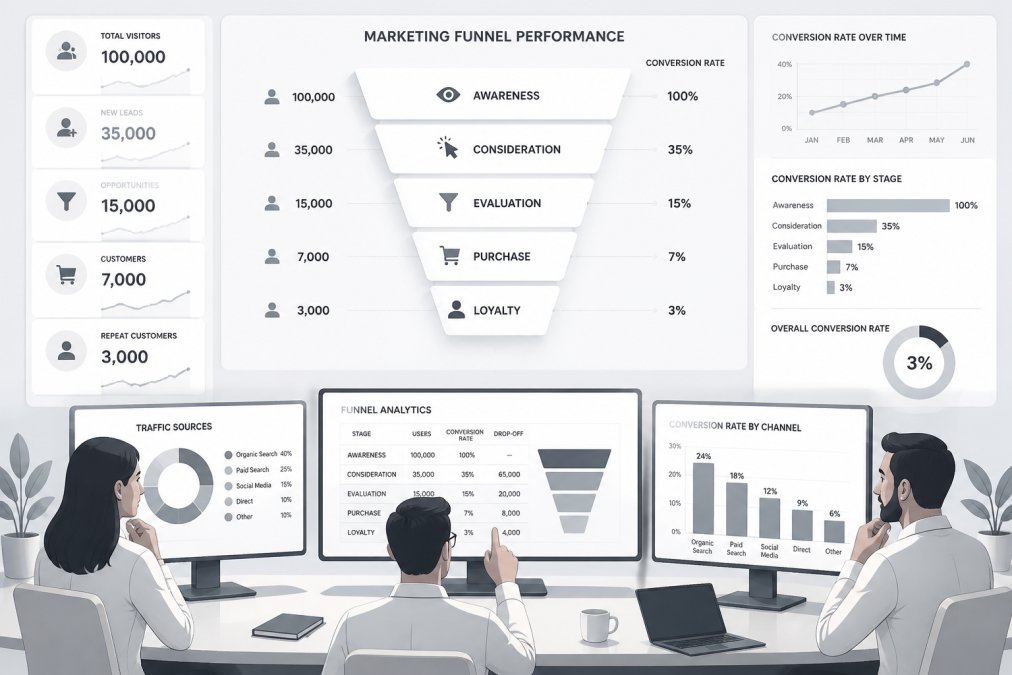
The most effective full-funnel strategies create a connected ecosystem where awareness campaigns feed into nurture sequences, which feed into sales conversations, which feed into retention programs.
Post-Acquisition Churn Mitigation and Retention
Many growing companies acquire customers and then neglect them. Churn, the percentage of customers who stop using your product, is the silent killer of sustainable growth. If you spend $1,000 to acquire a customer but they leave after one month, you’ve lost money.
Post-acquisition churn mitigation starts immediately after signup. The first 30 days are critical. Customers need to experience value quickly, understand how to use your product, and see results. Effective retention strategies include onboarding sequences guiding new customers through setup, regular check-ins identifying issues before they become deal-breakers, proactive education helping customers extract more value, and community opportunities deepening engagement.
A 5% improvement in annual retention can increase customer lifetime value by 25-100%, depending on your business model.
Set up automated check-ins at 7, 14, and 30 days post-purchase. Ask customers about their experience and identify friction early. Customers receiving proactive outreach in their first month are significantly more likely to remain active.
Digital Marketing Strategies for Growing Businesses
Digital channels offer growing companies unprecedented precision in targeting and measurement. You can see exactly where prospects came from, what content they engaged with, and whether they converted.
Data-Driven Decision Making and Analytics
Data-driven decision making bases marketing choices on evidence rather than intuition. The foundation is tracking: which channels deliver customers, at what cost, and with what quality. You need to measure conversion rates at each funnel stage.
Identify your three most important metrics, the ones most directly reflecting business growth. For a SaaS company, this might be monthly recurring revenue, customer acquisition cost, and churn rate. Build dashboards tracking these daily and make decisions based on whether they’re improving.
A/B Testing and Experimentation Frameworks
A/B testing compares two versions of a marketing element to determine which performs better. A practical approach:
- Identify a metric to improve directly connected to business outcomes.
- Form a hypothesis about what change will improve it.
- Design the test with only one variable differing between versions.
- Run long enough for statistical significance, typically 100-200 conversions per variation.
- Analyze results and determine if the difference is statistically significant.
- Implement the winner or run another test.
Small improvements compound. A 5% improvement in email open rates, 3% in landing page conversion, and 2% in checkout completion create a 10% overall improvement.
Declaring a test winner too early leads to false conclusions. Ensure sufficient sample size before drawing conclusions.
Content Marketing for Business Growth and SEO Integration
Content marketing creates valuable information that attracts and engages your target audience. For growing companies, it serves multiple purposes: attracting prospects through search engines, building trust through expertise demonstration, generating leads, supporting sales, and reducing support burden.
A marketing strategy for growing companies must integrate content marketing with SEO, optimizing content to rank highly in search results for queries your target customers use. Content ranking on page one of Google delivers consistent traffic for months or years.
Building a Repeatable Content Distribution System
Creating great content is only half the battle. Distribution is the other half. A practical content distribution system includes:
Content publication: Optimize for search engines with relevant keywords, clear headings, and internal links.
Social media distribution: Share across relevant platforms multiple times.
Email list promotion: Send emails highlighting new content to interested subscribers.
Paid amplification: Run ads on high-performing content to reach larger audiences.
Repurposing: Turn one blog post into videos, podcasts, slide decks, social posts, and email courses.
Create a checklist or process you follow for every piece of content. Without a system, distribution is inconsistent and inefficient.
Target Audience Identification and Buyer Persona Development
Successful marketing requires precision targeting. Not all customers are equally valuable. Some are more profitable, easier to sell to, or generate higher lifetime value.
A buyer persona is a detailed representation of your ideal customer, including demographics, psychographics, behavior, and pain points. Instead of "marketing manager," describe "marketing manager at a B2B SaaS company with $5-20M revenue, responsible for lead generation, frustrated with low conversion rates."
The most common mistake is defining target audiences too broadly. "Any business that wants to grow" is not useful. Narrow targeting makes marketing more effective, not less.
Marketing Budget for Growing Companies: Unit Economics and ROI
A marketing budget for growing companies must be built on unit economics, the financial relationship between acquisition spending and customer worth.
Customer Acquisition Cost (CAC) and Lifetime Value (LTV) Ratios
Customer acquisition cost (CAC) is total marketing spend divided by customers acquired. If you spend $10,000 and acquire 10 customers, CAC is $1,000.
Customer lifetime value (LTV) is total revenue expected from a customer over their entire relationship. If a customer pays $100 monthly for 24 months, LTV is $2,400.
A healthy CAC:LTV ratio is typically 1:3 or better, for every dollar spent acquiring a customer, they generate at least three dollars in revenue. A 1:1.5 ratio means you’re spending too much relative to customer worth. A 1:5 ratio means you have room to increase marketing investment while maintaining profitability.
For growing companies, improving unit economics often matters more than increasing total spend.
Building a Marketing Tech Stack That Scales
A marketing tech stack is your collection of tools and software. A poorly chosen stack creates friction and generates poor data. A well-chosen stack accelerates execution and provides clear visibility.
Start with fewer tools and add strategically as you grow. Core tools include:
- Website platform (WordPress, Webflow), where content lives
- Analytics (Google Analytics), tracking visitor behavior
- Email marketing (Mailchimp, Klaviyo), managing campaigns and lists
- CRM (HubSpot, Pipedrive), tracking relationships and pipeline
- Forms and landing pages (Unbounce, Leadpages), capturing leads
| Marketing Tool Category | Purpose | Typical Adoption Stage |
|---|---|---|
| Website Platform | Content hosting and publishing | Day 1 |
| Analytics | Tracking visitor behavior and conversions | Week 1 |
| Email Marketing | Email campaigns and list management | Month 1 |
| CRM | Customer and prospect tracking | Month 2-3 |
| Forms/Landing Pages | Lead capture | Month 1-2 |
| Social Media Management | Multi-platform posting and scheduling | Month 3-4 |
| Marketing Automation | Behavioral triggers and workflows | Month 6+ |
| Paid Advertising | Ad campaign management | Month 3+ |
Before adding a new tool, ask: “What problem does this solve that current tools don’t?” If the answer is “slightly more convenient,” don’t add it. Tool sprawl creates complexity and data fragmentation.
Customer Acquisition and Growth Engine Optimization
A growth engine is a system where each component feeds into the next, creating compounding returns. Early-stage engines are often powered by a single channel. As you scale, you build multiple channels working together.
Lead Generation and Marketing Automation
Lead generation identifies and attracts potential customers through organic search, paid search, content marketing, email, social media, referrals, and sales outreach.
Marketing automation uses software to execute marketing tasks based on triggers or conditions. When someone signs up, automated email sequences trigger. When a prospect visits pricing three times, they’re flagged for sales. Without automation, growing companies cannot maintain consistent communication with thousands of prospects.
A practical workflow:
- Attract: Create content or run ads attracting interested prospects
- Capture: Use forms to capture email and basic information
- Qualify: Use automated scoring to identify likely buyers
- Nurture: Send automated sequences based on interests and behavior
- Convert: Route qualified leads to sales
- Close: Sales follows up with qualified leads
- Retain: Automated onboarding and check-ins ensure customers experience value
Using AI Tools and Predictive Analytics
AI is rapidly changing marketing. AI analyzes customer data to predict conversion likelihood, generates content variations at scale, optimizes email timing, and identifies patterns humans would miss.
Practical applications include predictive lead scoring, content optimization, email subject line optimization, customer churn prediction, and personalization at scale.
AI is a tool, not a strategy replacement. It optimizes execution but cannot replace human judgment in setting direction.
Define success metrics before adopting AI tools. “Improve email open rates by 10%” is measurable. “Use AI for better marketing” is not.
Implementing Your Marketing Strategy: Change Management and Execution
Having a great strategy is only valuable if you execute it. Many growing companies have solid strategies that fail due to poor change management, unclear ownership, or misalignment.
Creating a Repeatable System for Continuous Improvement
Execution at scale requires systems and processes. A repeatable system includes documented processes for common tasks, ensuring consistency and reducing onboarding time.
Include process documentation, templates, checklists, metrics and reporting, and regular review cycles. Successful growing companies treat marketing as a continuously improving system. They measure results, identify what works, and adjust accordingly.
Common Mistakes Growing Companies Make
Understanding common mistakes helps you avoid them:
Lack of focus: Trying everything at once, spreading teams thin. Focus on 2-3 channels delivering best results.
No measurement: Running campaigns without clear success metrics.
Inconsistent execution: Starting initiatives and abandoning them before they work.
Poor targeting: Reaching everyone instead of ideal customers.
Misalignment between marketing and sales: Marketing generates leads sales doesn’t follow up on.
Underinvestment in retention: Spending 80% on acquisition, 20% on retention.
Tool sprawl: Using too many disconnected tools creating data silos.
No clear ownership: Unclear responsibilities and no accountability for results.
Avoiding these mistakes often matters more than getting everything else right. A company with a simple strategy executed consistently outperforms one with a sophisticated strategy executed inconsistently.
Growing a company requires marketing fundamentally different from traditional brand marketing. You need systems generating measurable revenue growth, not just awareness. You need to understand unit economics and optimize for profitable acquisition. You need repeatable processes scaling with your team. At My Chief Marketing Officer, we help growing companies build these systems through fractional CMO services providing strategic direction and operational execution. Our proprietary M.A.R.S. Method of Engagement & Execution consolidates fragmented marketing into a cohesive growth engine, allowing you to accelerate revenue growth while reducing full-time executive costs. Schedule your free session today to discuss how we can help you build a marketing strategy for growing companies that drives results.
Frequently Asked Questions
What is the difference between growth marketing and traditional marketing strategies?
Growth marketing focuses on rapid, scalable expansion through data-driven experimentation and full-funnel optimization, while traditional marketing emphasizes brand awareness and broad messaging. Growth marketing emphasizes measurable metrics like customer acquisition cost (CAC), lifetime value (LTV), and conversion rate optimization. For growing companies, this means prioritizing repeatable systems and continuous improvement over one-time campaigns.
How do I identify my target audience for a marketing strategy?
Start by developing detailed buyer personas based on real customer data, demographics, pain points, buying behaviors, and decision criteria. Use analytics to segment your existing customer base and identify high-value profiles. Conduct customer interviews and surveys to understand search intent and objections. Map these personas to each stage of your customer journey to inform messaging and channel selection across your marketing strategy.
What marketing budget should a growing company allocate?
Budget allocation depends on your unit economics, specifically the ratio between customer acquisition cost (CAC) and lifetime value (LTV). A healthy CAC:LTV ratio is typically 1:3 or better. If your LTV is $30,000, you can justify spending $10,000 to acquire a customer. Growing companies should allocate 7-12% of revenue to marketing, adjusting based on growth stage, competitive intensity, and your target market.
How can a fractional CMO help implement a marketing strategy without a full-time hire?
A fractional CMO provides strategic leadership, framework development, and direct oversight without the cost of a full-time executive. They consolidate fragmented marketing efforts into a cohesive, data-driven system, implement marketing automation and AI tools for efficiency, and ensure accountability through regular performance reviews. This model offers access to experienced strategic direction while maintaining flexibility and reducing overhead, ideal for growing companies with limited budgets.
What are the most effective digital marketing strategies for growing businesses?
The most effective strategies combine content marketing for SEO, lead generation through marketing automation, A/B testing for conversion rate optimization, and omnichannel customer engagement. Prioritize channels where your target audience spends time. Use predictive analytics to identify high-intent prospects. Implement attribution modeling to understand which touchpoints drive revenue. Focus on building a scalable, repeatable growth engine rather than one-off campaigns.
How do I reduce customer churn after acquisition?
Post-acquisition churn mitigation requires a structured onboarding process, regular engagement metrics tracking, and proactive customer feedback loops. Implement retention-focused campaigns within the first 30-90 days, segment customers by engagement level, and address at-risk segments early. Use predictive analytics to identify churn signals. Build product-led growth strategies that increase switching costs. Strong retention directly improves LTV and reduces the pressure on acquisition budgets.
What marketing tech stack do I need to scale efficiently?
A scalable marketing tech stack includes: a CRM for customer data management, marketing automation platform for lead nurturing, analytics tool for attribution modeling, content management system for SEO, and AI-powered tools for predictive insights. Start with core platforms and integrate gradually. Avoid tool sprawl, consolidation improves data flow and decision-making. Assess your stack's maturity: basic (foundational tools), intermediate (integrated workflows), or advanced (AI-driven optimization).

Share this Post