

Table of Contents
- What Is a Fractional CMO and Why Small Businesses Need One
- Signs Your Business Is Ready for Fractional CMO Leadership
- Fractional CMO Pricing Models: What You’ll Actually Pay
- Fractional CMO vs Marketing Agency: Which Fits Your Business
- How to Find and Vet a Fractional CMO: Key Interview Questions
- Integration and Knowledge Transfer: Protecting Your Marketing Investment
- Getting Started: Your Next Steps
Last Updated: August 9, 2026
What Is a Fractional CMO and Why Small Businesses Need One
A fractional CMO for small business is an experienced Chief Marketing Officer who works part-time or on a contract basis, providing strategic marketing leadership without the cost of a full-time executive. Rather than a $150K-$250K annual salary commitment, you gain senior-level marketing expertise on a flexible, scalable engagement model.
Small business owners face a critical gap: they need strategic marketing direction, but their revenue doesn’t yet support a full-time CMO. A fractional CMO bridges that gap by consolidating fragmented marketing efforts, building cohesive strategy, and driving lead generation while you retain budget control.
The role differs fundamentally from hiring a marketing agency or consultant. An agency executes tactics. A fractional CMO owns your marketing strategy, accountability, and results. They understand your business deeply, sit in on leadership meetings, and take responsibility for revenue impact, a fiduciary partner in your growth, not a vendor.
Small businesses typically need fractional CMO leadership when they’ve outgrown DIY marketing but can’t justify full-time overhead. You have product-market fit and growing revenue, but marketing efforts feel scattered: Facebook ads, email campaigns, and sales outreach run in silos with no unified strategy connecting them to lead generation.
My Chief Marketing Officer delivers this through our proprietary M.A.R.S. Method of Engagement & Execution, which consolidates fragmented marketing into a results-driven ecosystem combining strategic oversight with operational execution.
Signs Your Business Is Ready for Fractional CMO Leadership
Your business is ready when marketing decisions are slowing you down. If your founder spends 10+ hours weekly on marketing tasks, writing emails, analyzing campaigns, prioritizing channels, you’re burning executive time on execution. A fractional CMO reclaims that time for revenue-generating activities.
Another signal: your marketing produces results, but you don’t understand why. You’re getting leads without knowing customer acquisition cost or which channel drives revenue. This scattered approach means you’re likely leaving 30-50% of potential revenue on the table.
You’re also ready when you’ve hit a growth plateau. Word-of-mouth and founder effort no longer suffice. Your sales team needs a consistent pipeline of qualified leads, but your brand positioning is unclear, making differentiation difficult. The earlier you establish coherent marketing strategy and scalable lead generation, the faster you’ll reach establishment.
Team frustration is another signal. Your marketing coordinator lacks strategic direction. Your sales team complains about lead quality. Your founder makes marketing decisions in a vacuum. A fractional CMO provides the oversight and framework that transforms fragmented efforts into coordinated, results-driven work.
Fractional CMO Pricing Models: What You’ll Actually Pay
Fractional CMO pricing varies based on engagement model, scope, and experience level. The most common model is a monthly retainer, typically ranging from baseline to higher-touch partnerships depending on hours and scope. Retainers provide predictability and incentivize long-term success rather than billable hours, often structured around specific deliverables: strategy development, monthly performance reviews, team leadership, and execution oversight.
Project-based pricing works for defined initiatives like brand positioning audits or go-to-market strategies, but ongoing strategic leadership typically requires retainer engagement since marketing is continuous work.
A full-time CMO salary plus benefits typically costs $150K-$300K annually. A fractional engagement usually ranges from 30-70% of that cost depending on hours and scope. If you’re currently spending on agencies, consultants, or marketing tools without strategic coordination, a fractional CMO often costs less while delivering significantly better results.
The real question isn’t cost but ROI. A fractional CMO who consolidates marketing, improves lead quality, and increases customer acquisition efficiency often pays for themselves within 6-12 months through improved conversion rates and reduced wasted spend.
When comparing providers, look beyond headline numbers. What’s included? How many hours monthly? What deliverables? How much direct access to the CMO versus junior staff? My Chief Marketing Officer emphasizes direct contact with project and strategy directors, ensuring you’re not getting junior-level support at senior pricing.
Fractional CMO vs Marketing Agency: Which Fits Your Business
The choice between a fractional CMO and a marketing agency comes down to what you need: strategic leadership or tactical execution.
A marketing agency is a vendor executing campaigns, managing channels, producing content, and delivering outputs. Agencies excel for clear, defined projects like campaign launches or website redesigns. They bring specialized skills and scale execution quickly.
A fractional CMO is a leader owning your marketing strategy, accountability, and results. They ask hard questions: Are we targeting the right customer? Is our positioning clear? Which channels drive revenue? They build systems, align your team, and make trade-off decisions about budget allocation. A fractional CMO works with your existing team rather than replacing it.
Most small businesses that hire agencies find themselves trapped: the agency executes tactics, but nothing changes strategically. The business remains unclear on positioning, still has fragmented marketing, still doesn’t understand which efforts drive revenue. The agency isn’t responsible for strategy, just execution.
A fractional CMO audits current marketing, identifies gaps and inefficiencies, builds cohesive strategy, and ensures execution aligns with it. They might recommend stopping certain tactics entirely. They consolidate tools, eliminate redundancy, and build a lead-generation ecosystem where each channel serves clear purpose. They also provide ongoing oversight, reviewing performance regularly and adjusting strategy based on results.
The best setup for many small businesses is a fractional CMO providing strategic leadership plus specialized agencies for specific execution needs. Your fractional CMO coordinates everything, ensuring coherence and accountability. This hybrid approach costs less than a full-time CMO plus multiple agencies while delivering better results than either alone.
How to Find and Vet a Fractional CMO: Key Interview Questions
Finding the right fractional CMO requires rigor. You’re evaluating someone who will influence strategy, spend your budget, and impact revenue.
Start with track record. Ask for specific examples of similar-sized businesses in your industry with concrete results: revenue at start, revenue after 12 months, specific changes made. A fractional CMO should have measurable case studies, not just client names.
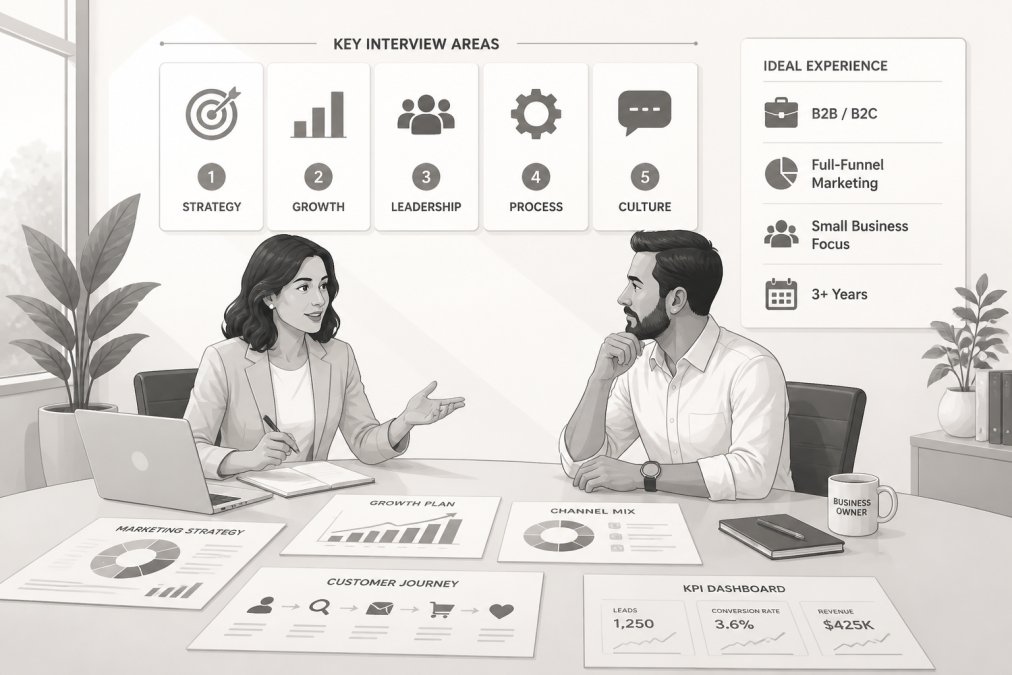
Ask directly: "How much time will you actually spend on my account?" This addresses concerns about divided attention. A credible fractional CMO specifies hours per week, availability, and capacity limits, how many clients they manage simultaneously.
Schedule Your FREE Session Today! →
Dig into their approach. Ask how they’d approach your business specifically: What would they audit first? How do they move from assessment to strategy? A strong fractional CMO asks detailed questions about your customer, competitive position, current spend, and revenue model, tailoring strategy rather than pitching generic approaches.
Test industry knowledge. Can they speak credibly about your competitive landscape and customer acquisition challenges? Generic responses are warning signs.
Ask about team and resources. Do they work solo or tap a team for execution? How do they manage quality and cost? My Chief Marketing Officer ensures direct access to project and strategy directors, meaning you’re not working through junior staff layers.
Discuss knowledge transfer and exit strategy. What happens if the engagement ends? Do they document strategy and processes so your team continues? A fractional CMO who leaves you stranded without knowledge transfer is a liability.
Finally, assess communication and working style. How often will you connect? How do they prefer communicating? Are they responsive and collaborative?
Integration and Knowledge Transfer: Protecting Your Marketing Investment
A major concern about fractional CMO engagement is continuity. What happens if your fractional CMO leaves?
The answer depends on engagement structure. A fractional CMO operating as a true partner builds systems and processes living in your organization, not in their head.

From day one, your fractional CMO should document strategy, processes, and decisions. Your marketing roadmap, customer acquisition strategy, positioning framework, and channel priorities should be written and accessible to your team. Your fractional CMO should train your team on the "why" behind decisions, not just what to do. When they leave, your team should execute the strategy, even if they need occasional guidance for new initiatives.
The best relationships include a formal knowledge transfer plan. Before engagement ends, there’s a transition period where the fractional CMO documents everything, trains your team, and ensures your internal team owns the work going forward. This might include recorded training, written playbooks, and gradual responsibility handoff.
Some businesses use a "stepping back" approach where the fractional CMO reduces hours gradually, moving from strategic leadership to advisory. Others prefer clean transition with thorough documentation and complete handoff.
Make knowledge transfer non-negotiable from the start. Include it in your engagement agreement, specifying that your fractional CMO will maintain documentation, conduct team training, and provide formal transition planning if the engagement ends.
My Chief Marketing Officer prioritizes this through our M.A.R.S. Method, designed to be transferable. The framework, processes, and decision logic live in your organization, not with the individual fractional CMO. If you transition to a different leader, your next CMO can step in and understand your established system.
Getting Started: Your Next Steps
If fractional CMO leadership makes sense for your business, evaluate whether your situation is the right fit.
Ask yourself: Do you have product-market fit and revenue to invest in marketing leadership? Are you ready to commit to a 6-12 month engagement? Do you want strategic partnership, not just tactical execution? If yes to these, you’re a candidate.
The next move is a conversation. Talk to fractional CMO providers about your situation. Describe your business, current marketing challenges, and growth goals. Ask them to assess whether they can help and what engagement would look like.
When evaluating options, remember that cheapest isn’t always best value. A fractional CMO costing 20% more but delivering measurable revenue impact is the better investment.
My Chief Marketing Officer offers a free session to discuss your situation, evaluate your marketing challenges, and determine if fractional CMO leadership is the right next step. This conversation clarifies what’s possible and what engagement entails, with no commitment.
The fractional CMO model exists because small businesses need strategic marketing leadership but can’t yet support full-time executive overhead. If you’re at that inflection point, past DIY marketing but not ready for a full-time CMO, fractional engagement accelerates growth and provides strategic clarity that transforms scattered marketing into coherent, results-driven systems.
The gap between your current marketing and where it needs to be is often strategy, not budget. A fractional CMO closes that gap by providing senior-level leadership, consolidating fragmented efforts, and building a lead-generation ecosystem driving predictable revenue growth. My Chief Marketing Officer delivers experienced fractional CMOs working directly with you on strategy and execution using our proprietary M.A.R.S. Method to simplify marketing operations and accelerate results. Schedule your free session today to explore how fractional CMO leadership can transform your marketing and unlock your growth potential.
Frequently Asked Questions
How much does a fractional CMO cost for a small business?
Fractional CMO pricing depends on engagement scope, hours per week, your industry, and the consultant's experience level. Costs vary based on whether you need part-time strategic oversight or hands-on execution support. Visit My Chief Marketing Officer's website to request a custom quote aligned with your specific business needs and marketing goals.
What's the difference between a fractional CMO and a marketing agency?
A fractional CMO is a senior marketing leader who owns your strategy and execution as a strategic partner, typically working 10-20 hours weekly and reporting directly to you. A marketing agency provides services (design, content, ads) but doesn't own your overall marketing direction. A fractional CMO vs marketing agency choice depends on whether you need strategic leadership or tactical execution, many businesses benefit from both working together.
When should a small business hire a fractional CMO?
Consider hiring a fractional CMO when you're struggling to scale revenue without marketing leadership, your marketing efforts feel fragmented across multiple tools and channels, you're planning a brand pivot or rebranding, or your team lacks clear strategy direction. If you have a marketing budget but no senior leader to optimize it, a fractional CMO can consolidate your efforts and accelerate growth without the cost of a full-time executive.
How do I know a fractional CMO will actually prioritize my business?
Ask potential candidates about their current client load, typical weekly availability, and how they structure communication and accountability. Request references from similar-sized businesses and clarify response times for strategic decisions. A reliable fractional CMO should commit to specific hours, have a clear exit strategy in place, and provide direct access to project and strategy oversight, not delegate your account to junior staff after onboarding.

Share this Post