

Table of Contents
- Why Hiring a Marketing Executive Matters for Revenue Growth
- Growth Marketing Executive Job Description Essentials
- Growth Marketing Salary Benchmarks and Compensation Structure
- Growth Marketing Interview Questions to Evaluate Candidates
- Growth Marketing KPIs and Metrics to Track Performance
- The Hiring Strategy: Timing and Implementation
- Building a Growth Marketing Competency Framework
- Conclusion
Last Updated: August 8, 2026
Why Hiring a Marketing Executive Matters for Revenue Growth
Fragmented marketing efforts lead to wasted budgets, conflicting priorities, and stalled growth. A marketing executive consolidates scattered initiatives into a coherent lead-generation ecosystem, establishing data-driven decision-making and aligning marketing with revenue goals. For founders without deep marketing expertise, this hire often represents the highest-ROI investment outside product development.
At My Chief Marketing Officer, we’ve worked with dozens of companies that brought in leadership only after years of inefficient spend. Through the strategic application of AI tools and our proprietary M.A.R.S. Method of Engagement & Execution, we consolidate fragmented marketing into a powerful, results-driven lead-generation ecosystem.
A marketing executive transforms marketing from a cost center into a revenue engine by aligning strategy, consolidating tools, and implementing data-driven processes that improve customer acquisition and retention.
Growth Marketing Executive Job Description Essentials
Core Responsibilities and Scope
A growth marketing executive owns the complete customer lifecycle, from awareness through retention, and is accountable for measurable revenue impact. Core responsibilities include developing go-to-market strategy aligned with business objectives, establishing growth metrics tied to revenue, managing the marketing technology stack, overseeing lead generation and customer acquisition, optimizing conversion rates at each funnel stage, and building or directing teams that execute these initiatives.
In practice, the executive spends roughly 40% on strategy and planning, 30% on execution oversight, 20% on team management, and 10% on stakeholder reporting. They’re comfortable with analytics dashboards and understand both brand positioning and performance marketing. They evaluate technology purchases, negotiate vendor contracts, and make hiring decisions that impact revenue.
The scope varies by company maturity. Early-stage companies need executives who execute hands-on while thinking strategically. Mid-market companies need someone focused primarily on team leadership and strategic planning. Either way, the executive must demonstrate fluency in both performance marketing and brand-building.
Required Experience and Competencies
Look for candidates with 7-10 years in marketing roles, including 3-5 years in leadership managing teams or full marketing functions. They should have direct responsibility for customer acquisition metrics and demonstrable results improving conversion rates or reducing customer acquisition costs.
Technical competencies matter significantly. The executive must understand marketing analytics, interpret data independently, and have hands-on experience with marketing automation platforms, CRM systems, and analytics tools. SQL literacy is increasingly expected.
Critical competencies include funnel optimization expertise, product marketing acumen, team building and coaching, and strategic thinking. Strong candidates actively test new approaches, read industry research, and adapt frameworks based on current performance, not historical patterns.
Avoid candidates whose experience is purely in brand marketing without measurable performance marketing results. They may excel at brand building but lack the data-driven, funnel-optimization mindset necessary for growth roles.
Growth Marketing Salary Benchmarks and Compensation Structure
Compensation varies significantly based on company stage, revenue, location, and whether the role is full-time or fractional.
For full-time Chief Marketing Officer or VP of Marketing roles: Series A/B companies (under $10M revenue) typically pay $120,000-$180,000 base plus 30-50% in equity and bonus. Companies with $10M-$50M revenue offer $150,000-$250,000 base plus equity and bonus. Companies above $50M revenue often exceed $250,000 base plus substantial equity and performance bonuses.
Fractional CMO services typically cost $3,000-$8,000 monthly for 10-20 hours weekly. This model offers significant advantages: experienced leadership without full-time salary, benefits, and overhead. My Chief Marketing Officer delivers fractional CMO services providing direct access to experienced directors who consolidate fragmented marketing efforts into unified, results-driven strategy.
The fractional model works well if you’re uncertain about full-time hire timing, want to test strategic direction before permanent commitment, or need specialized expertise without building a full department. The trade-off is that fractional executives work with multiple clients, limiting availability for every meeting.
Geographic location influences compensation significantly. San Francisco and New York executives command 20-30% premiums over secondary markets. Remote hiring expands your talent pool and can reduce compensation requirements.
Full-Time vs. Fractional CMO Costs
A full-time CMO earning $200,000 base costs $280,000-$320,000 annually when fully loaded with benefits, taxes, and overhead. This makes sense only with sufficient marketing complexity and revenue scale.
Fractional services eliminate most overhead costs. You pay for hours delivered, scale engagement based on needs, and avoid long-term employment commitments. If strategy isn’t working or fit isn’t right, you can adjust without navigating termination.
Many companies use a hybrid approach: hire a fractional CMO to establish strategy and build foundational processes, then transition to full-time once you’ve validated the approach and grown sufficiently.
Calculate your true cost of employment and compare it to fractional alternatives. For companies under $20M revenue without mature marketing departments, fractional leadership often delivers better ROI.
Growth Marketing Interview Questions to Evaluate Candidates
Interview processes should probe three dimensions: strategic thinking, execution capability, and team leadership. Generic questions won’t reveal these competencies.
Start with strategic questions revealing how candidates think about growth. Ask: "Walk me through your approach to identifying the highest-impact marketing initiative for a company in our industry. What data would you need?" Listen for candidates who ask clarifying questions about your business model, customer acquisition patterns, and competitive landscape rather than jumping to generic answers.
Follow with execution questions requiring specific examples. Ask candidates to describe a time they optimized a conversion funnel, what metrics they tracked, what hypotheses they tested, and what measurable results they achieved. Request specific numbers and timeframes. Candidates with real execution experience provide specific data; those without speak in generalities.
Assessing Data-Driven Decision Making
Ask candidates to walk through a recent marketing decision and explain the data that informed it. How did they define success? What metrics did they track? What did they do when results diverged from expectations?
Present a hypothetical scenario: "You’ve inherited a budget allocated 50% to paid search, 30% to content, and 20% to events. Events drive highest-quality leads but lowest volume; paid search drives volume but lower-quality leads. How would you reallocate?" Listen for candidates who ask clarifying questions about business model, customer lifetime value, and sales cycle before recommending changes.
Ask about their experience with marketing analytics tools and data infrastructure. How have they set up attribution models? What challenges have they encountered with data quality? Have they worked with data teams to build custom dashboards? Candidates who’ve built measurement systems understand the complexity of connecting marketing activities to revenue.
Evaluating Growth Hacking and Funnel Optimization Experience
Ask candidates to describe a time they identified and exploited an unexpected growth opportunity. What made them notice it? How did they test before scaling? What was the result?
Probe funnel optimization directly. Ask: "Walk me through the last funnel you optimized. What was the biggest bottleneck? How did you identify it? What experiments did you run?" Listen for systematic thinking: did they test incrementally and measure carefully, or make broad changes hoping for results?
Ask about growth metrics and KPIs. What metrics do they track obsessively? How do they balance leading indicators with lagging indicators? Do they understand cohort analysis, retention curves, and unit economics?

Growth Marketing KPIs and Metrics to Track Performance
Once hired, use clear metrics to evaluate your marketing executive’s performance and ensure the role delivers measurable value. Metrics should directly connect to revenue and reflect your business model.
Schedule Your FREE Session Today! →
Start with customer acquisition cost (CAC) and customer lifetime value (LTV). CAC should decline over time as your executive optimizes channels and improves conversion efficiency. LTV should increase as retention and expansion revenue improve. The LTV-to-CAC ratio should exceed 3:1 for sustainable growth; many SaaS companies target 4:1 or higher.
Track monthly recurring revenue (MRR) growth rate and attribute it to marketing activities. Your marketing executive should show which acquisition channels, campaigns, or initiatives drove the most revenue. Monitor conversion rates at each funnel stage: website visitor to lead, lead to qualified opportunity, opportunity to customer, and customer to expansion. Improvements in any stage compound.
Customer Acquisition and Retention Metrics
Track not just acquisition volume but quality. Monitor sales-accepted leads (SALs), qualified opportunities, and deal velocity. A marketing executive driving high-volume low-quality leads wastes budget without generating revenue.
Retention metrics reveal sustainability. Track monthly churn rate, net revenue retention (NRR), and customer expansion revenue. If customers are churning, either the product doesn’t match marketing expectations or wrong customer segments are being acquired.
Cohort analysis matters significantly. Compare how customers acquired through different channels, campaigns, or time periods perform over their lifetime. Some channels drive higher-LTV customers; others drive high-churn customers. This data should inform budget allocation decisions.
Conversion Rate Optimization and Lead Generation Benchmarks
Establish baseline conversion rates before your executive starts, then track improvements quarterly. A strong executive typically improves conversion rates by 5-15% annually through systematic testing. If rates are flat or declining after 90 days, the executive isn’t focusing sufficiently on optimization.
Monitor cost per lead, lead-to-SAL conversion rate, and SAL-to-customer conversion rate separately. This granularity reveals whether your executive is optimizing the right metrics. Track marketing qualified lead (MQL) to SAL conversion rates closely; low rates (below 20% for most B2B companies) indicate targeting or qualification issues.
The most important metrics connect directly to revenue: customer acquisition cost, customer lifetime value, monthly recurring revenue growth, and retention rates. If your marketing executive can’t articulate how their activities impact these metrics, the measurement infrastructure needs improvement.
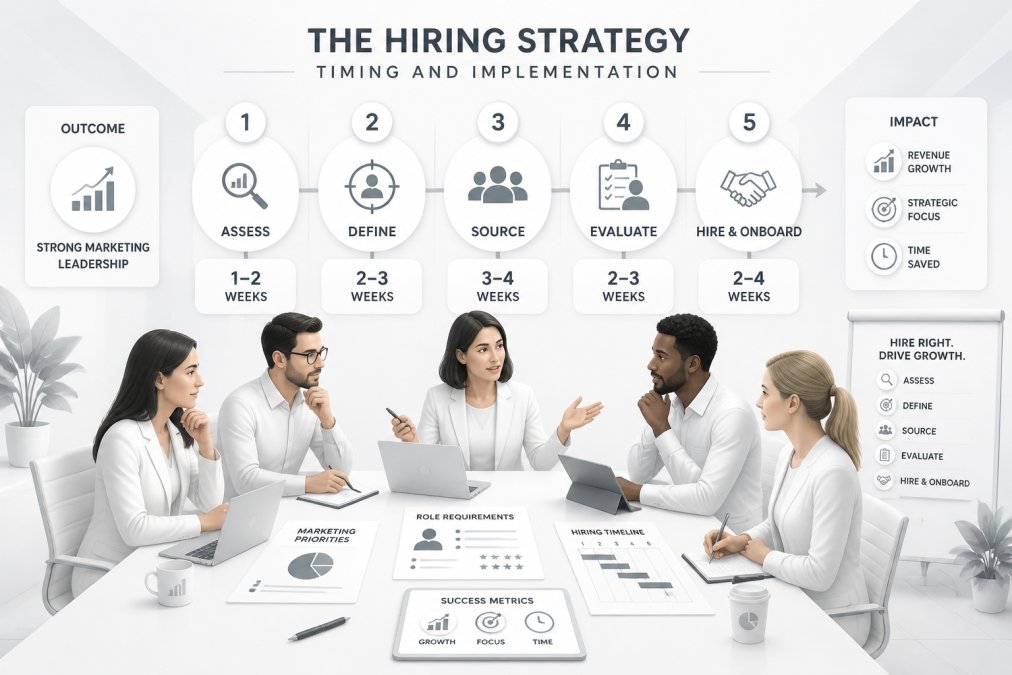
The Hiring Strategy: Timing and Implementation
Knowing when to hire a marketing executive and how to structure the role significantly impacts success. Hire too early and you’re paying for unneeded leadership. Hire too late and you’ve wasted years on inefficient spend.
Most companies should consider hiring a marketing executive when they’ve reached product-market fit and validated their customer acquisition model. This typically happens at $1-3M annual revenue for B2B SaaS or $2-5M for B2C companies. At this stage, you have sufficient marketing complexity to justify dedicated leadership.
If you’re earlier, a fractional CMO or marketing advisor makes more sense. You’re still validating your go-to-market approach and need flexibility to adjust quickly.
When Your Business Is Ready for a Marketing Executive
Several signals indicate readiness. First, you have multiple marketing channels running simultaneously without coordination. Second, you’re spending more than $50,000 monthly on marketing but can’t clearly attribute revenue to specific initiatives. Third, your sales team complains about lead quality or quantity. Fourth, you have 2+ marketing people but no clear leader, resulting in duplicated efforts or gaps.
The most critical signal is that you’ve validated your customer acquisition model and understand what works. Hire leadership to scale and optimize what you’ve proven, not to figure out how to acquire customers.
Evaluating Full-Time vs. Fractional Leadership
Full-time makes sense with sufficient marketing complexity, a team to manage, and budget to justify fixed costs. Fractional makes sense if you need strategic leadership but lack full-time budget, want to test strategic direction before permanent commitment, or need specialized expertise without building internal capability.
Many companies underestimate fractional leadership’s value. An experienced fractional CMO brings strategic frameworks and decision-making processes that compound over time. My Chief Marketing Officer’s fractional CMO model provides direct access to experienced directors who consolidate fragmented marketing efforts, implement proven frameworks, and ensure strategy aligns with revenue goals. This approach reduces overhead costs while maintaining strategic continuity and accountability.
The fractional model also reduces hiring risk. If strategy isn’t working or fit isn’t right, you can adjust without navigating termination and severance.
Consider a staged approach: hire a fractional CMO for 6-12 months to establish strategy and build foundational processes, then transition to full-time once your business has grown sufficiently and the need for full-time leadership is clear.
Building a Growth Marketing Competency Framework
Beyond hiring a single executive, consider building a competency framework defining what growth marketing excellence looks like in your organization. This framework guides hiring decisions, ensures consistent standards, and helps executives develop their teams.
A growth marketing competency framework typically includes five dimensions: strategic thinking, execution capability, data literacy, team leadership, and continuous learning. For each dimension, define specific competencies and proficiency levels. For example, under data literacy: junior level (interpret standard reports and understand basic metrics), mid-level (build custom reports and conduct cohort analysis), and senior level (design measurement frameworks and identify data infrastructure gaps).
Use this framework to guide professional development. If your marketing executive is strong in execution but weak in team leadership, invest in coaching to improve leadership capability. If your team lacks expertise in a specific channel, either hire someone with that expertise or invest in training existing team members.
Hiring a marketing executive for growth is one of the highest-use decisions you’ll make as a founder or CEO. The right leader transforms fragmented marketing efforts into a unified, revenue-driving engine. They establish data-driven decision-making, optimize your customer acquisition funnel, and build a team that compounds results over time.
The challenge is knowing when you’re ready, what to look for, and how to structure the role for success. If marketing complexity has outpaced your ability to manage it, or you’re spending significant budget without clear revenue attribution, it’s time to consider bringing in leadership. For many companies, a fractional CMO provides the strategic guidance and execution expertise you need without full-time cost commitment. My Chief Marketing Officer connects you with experienced directors who consolidate your marketing efforts, implement proven frameworks, and deliver measurable revenue growth. Schedule your free session today to explore whether fractional CMO services align with your growth stage and business needs.
Frequently Asked Questions
What is the average salary range for a growth marketing executive in the US?
Growth marketing executive salaries vary based on company size, location, and experience level. Full-time senior-level marketing executives typically earn between $120,000 and $250,000+ annually, with total compensation including equity and bonuses. Fractional CMO arrangements offer flexibility, allowing businesses to access experienced marketing leadership at lower overall cost than a full-time hire. Actual compensation depends on scope, commitment level, and whether the role includes equity participation or performance-based incentives.
What growth marketing KPIs and metrics should a marketing executive own?
A growth marketing executive should drive metrics across the entire customer lifecycle: customer acquisition cost (CAC), lifetime value (LTV), conversion rates at each funnel stage, retention rates, churn, and go-to-market strategy effectiveness. They own lead generation volume and quality, marketing-qualified lead (MQL) to sales-qualified lead (SQL) conversion, and campaign ROI. Additional critical KPIs include user acquisition costs by channel, product adoption rates, and revenue attribution by marketing initiative. These data-driven metrics form the foundation of performance marketing accountability.
When is the right time for a business to hire a marketing executive for growth?
Most growing companies benefit from marketing executive leadership when annual revenue reaches $2-5 million and growth is plateauing without strategic direction. If your business is struggling with fragmented marketing efforts, lacks unified lead-generation strategy, or needs to accelerate customer acquisition, executive-level guidance becomes essential. Companies undergoing brand pivots or entering new markets also need experienced leadership. A fractional CMO arrangement allows earlier-stage businesses to access this expertise without full-time salary and benefits costs.
How is a fractional CMO different from hiring a full-time marketing executive?
A fractional CMO provides experienced strategic marketing leadership on a part-time or project basis, consolidating fragmented marketing efforts and implementing proven frameworks without the overhead of a full-time hire. Full-time executives offer deeper immersion in company culture but require higher compensation, benefits, and longer commitment. Fractional arrangements give you direct access to experienced directors and strategists, faster decision-making, and the ability to scale support based on business needs. This model works well for SMBs and mid-market companies that need growth marketing expertise but lack the budget for a full-time role.

Share this Post