

Table of Contents
- Understanding the Difference Between Growth and Scaling Revenue
- Assess Your Operational Readiness Before Scaling
- Revenue Operations Best Practices for 2026
- How to Increase Profit Margins During Revenue Scaling
- Implementing Business Scaling Tools and Automation
- Building Scalable Revenue Models That Sustain Growth
- Align Sales and Marketing to Drive Revenue Acceleration
- Establish Key Performance Indicators for Scaling Success
Last Updated: August 7, 2026
Understanding the Difference Between Growth and Scaling Revenue
Growth means increasing revenue from current operations by adding customers, volume, or raising prices. Scaling means increasing revenue while maintaining or reducing operational costs per unit. Growth can happen through brute force effort; scaling requires systematic change. A business that grows 20% by hiring proportionally more staff hasn’t truly scaled. One that grows 20% while keeping headcount flat has.
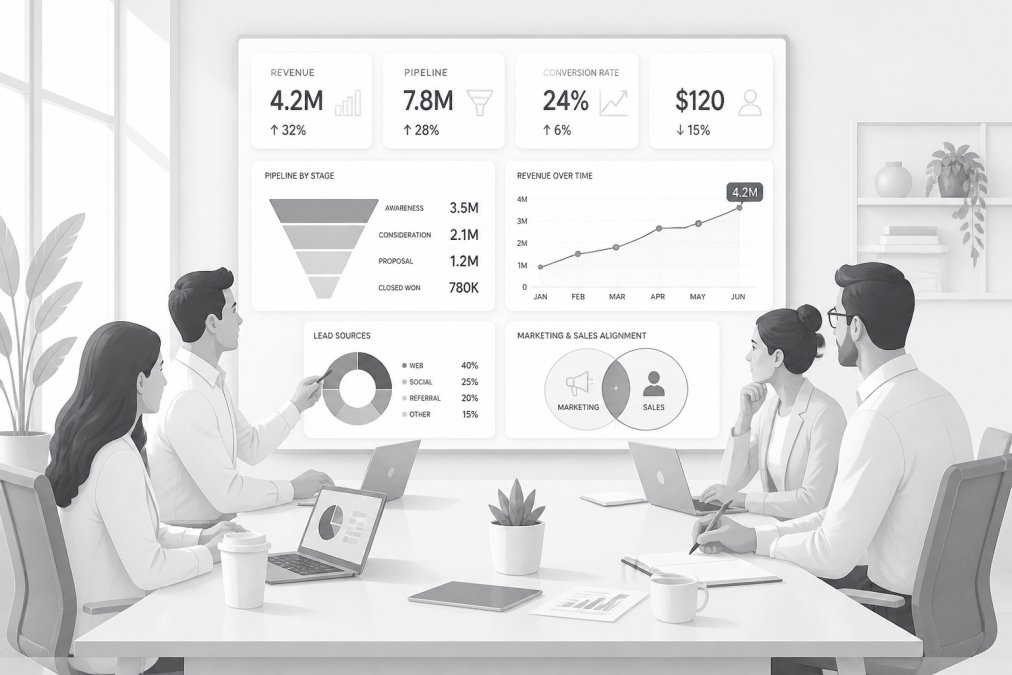
This distinction shapes strategy. A company pursuing growth needs more salespeople. A company pursuing scaling needs better sales processes, automation, and data-driven decision-making. Growth without scaling is a treadmill where you’re always adding resources to maintain momentum. Scaling builds systems that multiply output without proportional input increases, expanding profit margins and compounding competitive advantage.
Assess Your Operational Readiness Before Scaling
Before scaling revenue, honestly assess whether your operations can handle it. Many businesses rush to grow without fixing foundational problems, creating crises the moment they succeed.
Document your current processes: customer acquisition, onboarding, and delivery. If critical functions depend on individuals rather than systems, you’re not ready to scale. Measure how long each process takes and identify dependencies.
Evaluate your data infrastructure. Can you track customer acquisition cost, lifetime value, churn rate, and conversion rates? If you’re making decisions on gut feel, scaling will magnify mistakes. You need reliable data flowing through your business.
Assess your team’s capacity and capability. Do they have skills to execute at larger scale? Can they manage complexity and ambiguity? Scaling requires people who think systematically. If your team is stretched thin today, adding volume will break them.
Finally, examine your financial runway. Scaling typically requires upfront investment before returns materialize. Do you have capital to fund this gap? Many promising efforts fail because the business runs out of cash before the model works.
Revenue Operations Best Practices for 2026
Revenue operations, aligning sales, marketing, and customer success around shared metrics and processes, is essential for scaling. Businesses that treat these functions as silos fall behind; those that integrate them around revenue outcomes move faster.
Establish a single source of truth for customer data. Your CRM should be the authoritative record of every customer interaction, opportunity, and outcome. Most businesses have fragmented data across email, spreadsheets, and disconnected tools. When sales can’t see marketing communications and customer success can’t see sales conversations, you lose context. Integration matters more than tool choice.
Align metrics across teams. Marketing should be measured on lead quality and cost per qualified lead, not just volume. Sales on revenue closed and sales cycle length, not just activity. Customer success on retention and expansion revenue, not just support tickets. When everyone optimizes for different outcomes, you create friction.
Automate repetitive workflows. Manual handoffs between teams are a competitive disadvantage. When a prospect becomes qualified, that transition should be automatic. When a customer is onboarded, that information should flow to customer success without human intervention. Tools like Zapier or native workflow automation eliminate busy work that prevents strategic thinking.
Establish regular cadence meetings between teams, weekly alignment on pipeline and metrics, monthly strategy discussions. These should be short and focused to surface issues early and enable fast decisions.
How to Increase Profit Margins During Revenue Scaling
Scaling revenue without protecting profit margins is a trap. You can grow revenue 50% while profit declines if your cost structure isn’t right.
Improve operational efficiency. Look at your cost structure and identify waste: manual work that could be automated, unused tools, or inefficient processes. Many businesses find 20-30% of operational costs are pure waste.
Optimize customer acquisition cost relative to lifetime value. As you scale, acquisition costs typically rise because you’ve exhausted cheap channels. Focus acquisition spend on customer segments with highest lifetime value. A customer paying $500/month for 3 years is worth more than one paying $200/month for 1 year.
Reduce churn. Retaining existing customers is typically 5-10x cheaper than acquiring new ones. If you’re growing 20% but losing 15% annually, you’re on a treadmill. Understand why customers leave and fix those problems.
Optimize pricing. Many businesses underprice from fear of losing customers. If you have strong retention and clear value, you often have room to raise prices. Even a 10% increase on existing customers can significantly expand margins.
Implementing Business Scaling Tools and Automation
The right tools accelerate scaling; the wrong ones create complexity. Choose tools that integrate with your existing stack rather than adding isolated solutions.
Your CRM is foundational, where customer relationships live. Everything else integrates with it. Whether you choose Salesforce, HubSpot, or Pipedrive depends on complexity and budget, but you need one.
Implement marketing automation connected to your CRM. This nurtures leads at scale without manual effort. Email sequences trigger based on behavior. Lead scoring happens automatically. Prospects move through your funnel systematically.
Add analytics and reporting tools for funnel visibility. See where prospects drop off, which campaigns work, which channels convert best. Tools like Google Analytics or your CRM’s native reporting provide this.
Use workflow automation tools like Zapier to connect systems that don’t natively integrate. When a deal closes, automatically create a project. When a customer is added, automatically send a welcome email. These small automations compound into significant time savings.
The mistake most businesses make is tool proliferation. Start with 4-6 well-integrated core tools. Only add more when you’ve maxed out what those tools can do.
Building Scalable Revenue Models That Sustain Growth
A scalable revenue model is one where revenue increases significantly without proportional operational cost increases.
Subscription models are typically more scalable than project-based models because revenue becomes predictable and recurring. You spread customer acquisition cost across multiple months or years, improving unit economics.
Schedule Your FREE Session Today! →
Product-led growth models, where customers experience value before paying, often scale better than sales-heavy models because they reduce friction and lower acquisition costs.
Tiered pricing allows you to serve customers at different price points. A basic, professional, and enterprise tier let you capture more value from high-value customers while remaining accessible to smaller ones.
The key is understanding your unit economics. How much does it cost to serve one additional customer? How much revenue does that customer generate? If your cost per customer is declining as you scale, your model is scalable. If it’s increasing, redesign something.
Most businesses refine their model as they scale. What worked at $1M revenue might not work at $10M. Iterate based on real data rather than clinging to initial approaches.
Align Sales and Marketing to Drive Revenue Acceleration
When sales and marketing are misaligned, revenue growth slows. When aligned, growth accelerates.
Define what constitutes a qualified lead. Marketing and sales often disagree. Align on clear criteria: company size, industry, job title, or engagement level. A marketing qualified lead (MQL) meets specific criteria. A sales qualified lead (SQL) indicates buying intent through concrete actions.
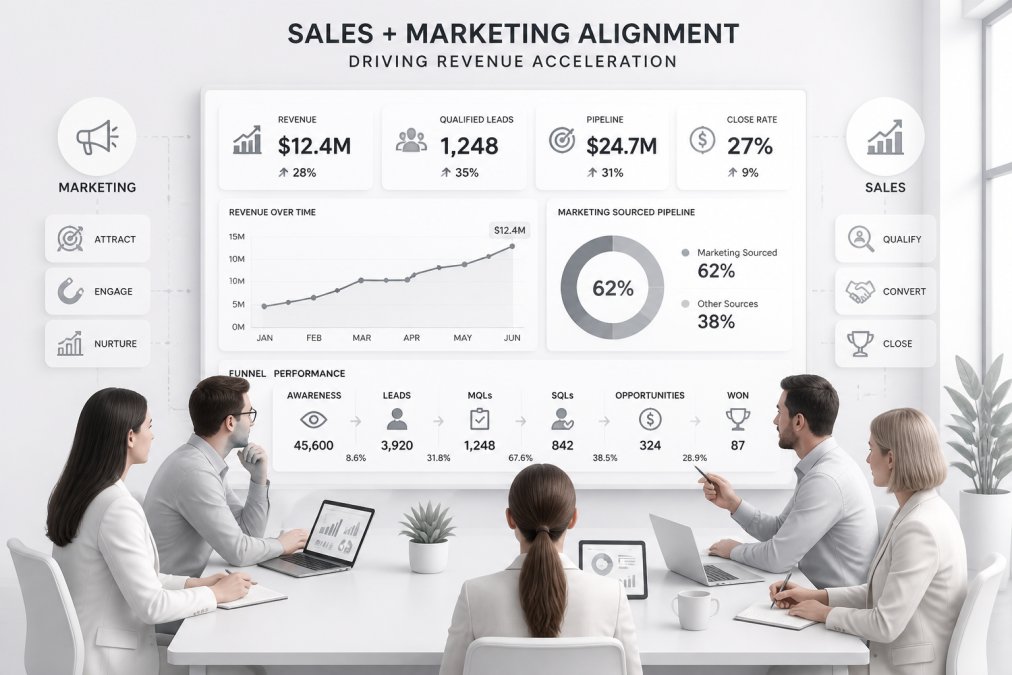
Create feedback loops between teams. Sales should tell marketing which leads convert. Marketing should tell sales what messaging resonates. This feedback should flow weekly or biweekly, not annually.
Align compensation. If sales is compensated only on revenue and marketing on lead volume, they’ll optimize for different things. Consider structures where both benefit from qualified pipeline and closed revenue.
Establish clear SLAs between teams. Marketing commits to X qualified leads per month at Y cost. Sales commits to 24-hour follow-up and feedback on lead quality. Clear expectations increase accountability.
Implement a formal lead scoring model. Leads get points for attributes and behaviors. Once they hit a threshold, they’re automatically routed to sales. This ensures consistent qualification.
Establish Key Performance Indicators for Scaling Success
You can’t scale what you don’t measure. Focus on metrics that actually drive revenue and profit.
Annual recurring revenue (ARR) or total contract value (TCV) is your north star, predictable, recurring revenue tracked monthly.
Customer acquisition cost (CAC) determines sustainability. Calculate it as total sales and marketing spend divided by new customers acquired. As you scale, CAC typically increases, but if it’s rising faster than customer lifetime value, your model isn’t scaling.
Customer lifetime value (LTV) is total profit expected from a customer over their entire relationship. This should be 3-5x your CAC. Track this religiously because it determines how much you can afford to spend acquiring customers.
Churn rate shows how many customers you’re losing monthly. Even 5% monthly churn compounds into serious problems. Track both logo churn and revenue churn.
Sales cycle length shows how long deals take to close. If it’s increasing dramatically, something is broken. Track by sales stage to identify where deals get stuck.
Win rate is the percentage of opportunities that close. This should be relatively stable. If it’s declining, your sales process or product-market fit may be deteriorating.
Conversion rate at each funnel stage shows where prospects drop off. Track by source, industry, and sales rep to identify patterns.
Create a dashboard showing these metrics updated weekly. Review them in team meetings. When a metric moves wrong, investigate immediately.
Scaling revenue in 2026 requires systematic thinking about operations, alignment between teams, and ruthless focus on metrics that matter. Most businesses can grow. Few can scale sustainably. The difference is in implementation discipline and building systems that work without constant heroic effort.
My Chief Marketing Officer helps founders and CEOs navigate this transition by consolidating fragmented marketing efforts into a results-driven lead-generation ecosystem. Through our proprietary M.A.R.S. Method of Engagement & Execution and strategic application of AI tools, we help you reclaim time, improve operational efficiency, and accelerate revenue growth while reducing the overhead of a full-time executive team. If your business is ready to scale, schedule your free session today to discuss your specific scaling challenges with our team of experienced strategists.
Frequently Asked Questions
What's the difference between growing and scaling revenue?
Growth means increasing revenue by adding more resources proportionally, hiring more salespeople or doubling your ad spend to get double the sales. Scaling revenue means increasing output without proportional increases in costs. A company that scales might triple revenue while only adding 20% more overhead. Scaling requires operational efficiency, automation, and better systems. Growth is linear; scaling is exponential.
How do AI tools and automation impact revenue scaling strategies in 2026?
AI tools reduce manual work, accelerate decision-making, and improve targeting precision. Marketing automation identifies high-intent prospects faster. Sales automation handles lead qualification and follow-up sequences. Predictive analytics reveal which customers have the highest lifetime value. The result: your team closes more deals without proportional headcount growth. In 2026, companies that skip AI integration fall behind on operational efficiency and profit margins.
What should I focus on first when building a scalable revenue model?
Start by understanding your customer acquisition cost (CAC) and lifetime value (LTV). If your LTV is less than 3x your CAC, you don't have a scalable model yet, fix unit economics first. Then document your sales process so it can be repeated and automated. Finally, align your sales and marketing teams around a unified lead-generation strategy. Without these foundations, scaling will drain cash rather than generate it.
Is a 10% revenue increase considered good in 2026?
It depends on your industry, stage, and market conditions. A 10% year-over-year increase is modest for a startup but solid for a mature enterprise. More important than the percentage is whether you achieved it while improving profit margins and maintaining operational efficiency. Sustainable scaling prioritizes profitable growth over vanity metrics. Focus on revenue quality, higher margins and lower churn, rather than raw top-line numbers.

Share this Post